
The Void Nobody Prepares You For
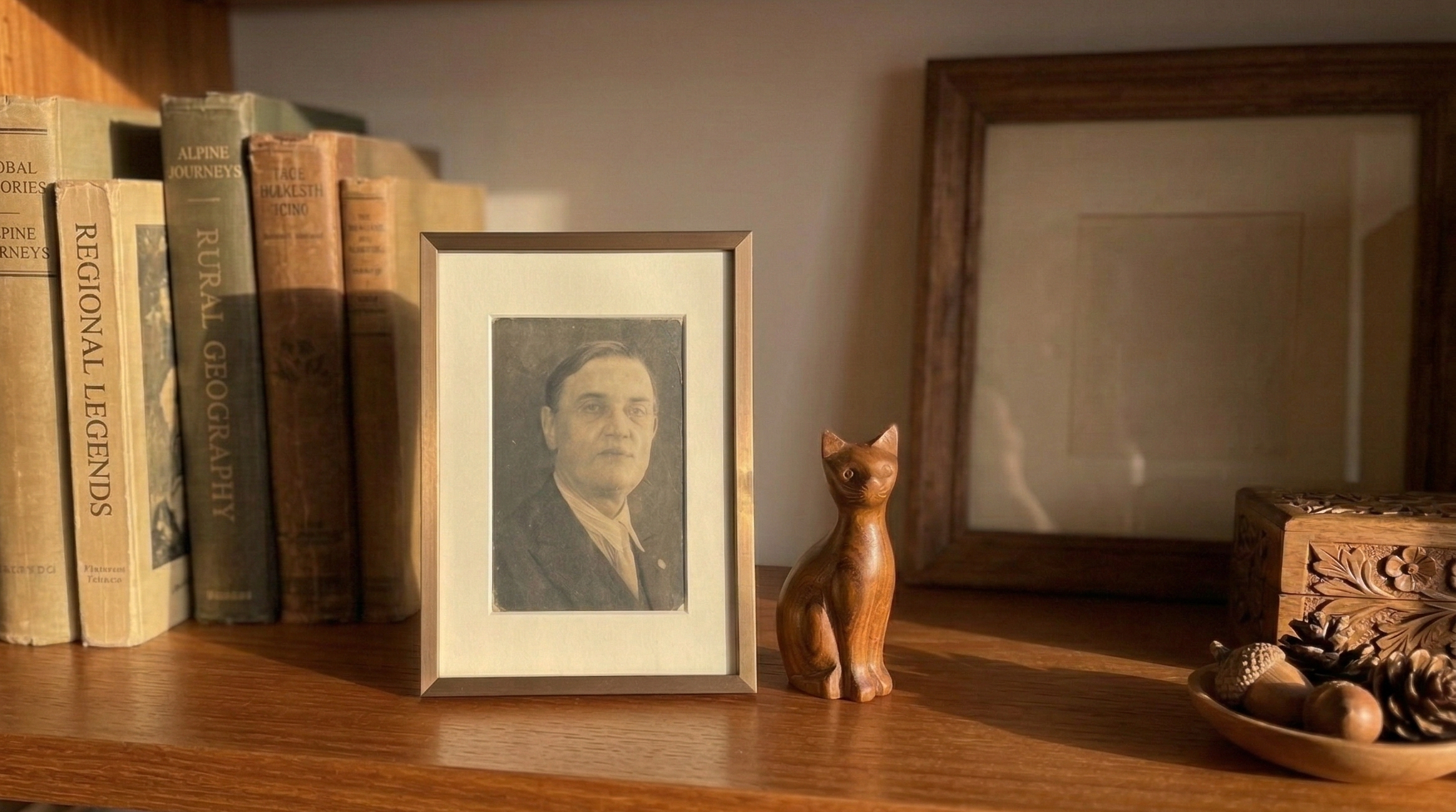
I want to talk to you about a void.
Not the void of grief — you know that one, it’s immense and it has a name. I’m talking about another void, more subtle, that comes after. When the pain has settled and you begin to take stock of what is no longer there. Not just the person. The person’s story.
When I lost my grandparents, I was left with memories of their final years. Only their final years. Everything else — the childhood I hadn’t lived alongside them, the decades in which they had built their lives before I even existed, the choices that had made them who they were — had already disappeared before I thought to ask. I was a teenager when there was still time. And at that age, nobody asks. At that age, life seems endless, and grandparents seem as though they’ve always been there, and tomorrow is always a good time for those questions.
Tomorrow never comes.
Of my great-grandparents I know almost nothing. Virtually nothing. And this frightens me in a way I still struggle to explain — because it’s not just nostalgia, it’s something more concrete. Perhaps my great-grandfather saw the world the way I do. Perhaps questions I’ve carried for years had already found an answer in someone who resembled me, and I lost him without knowing. I will never know. Those experiences, that way of being in the world, that wisdom accumulated in the silence of a lived life — they left with him, without leaving a trace.
Psychologists call this generativity — the deep human desire, characteristic of adulthood, to go beyond oneself. To leave something that survives. Not out of vanity — but for continuity. To keep the thread unbroken. It’s Erik Erikson who theorised it, but in reality it’s something we all feel, sooner or later, without needing to name it.
I felt it when I began to reckon with that void. And I understood that it wasn’t my problem alone. It was the problem of anyone who has loved someone who is gone, and finds themselves knowing too little about them.
I am not part of any elite. I have never been wealthy. I built a life piece by piece, project after project, often without a safety net — from a Hip Hop magazine founded in Italy in 1991, when almost nobody in Italy was talking about Hip Hop, to here. Nobody would write my biography. Nobody would take the trouble to collect and preserve my story, because I’m not famous enough, I don’t have the right credentials, I don’t fit neatly into the right box in the catalogue of collective memory.
And yet I want my daughter to know who I was. How I thought. How I loved. How a very shy person, at a certain point in his life, stepped out of his comfort zone and chose to stay there — for the rest of his life, building one project after another, from a magazine about a culture that taught me to do, not just talk, all the way to this: a project dedicated to giving all of humanity the possibility to be remembered.
Biography Library is this. It is the answer to that void. It is the refusal to accept that the memory of billions of ordinary people — those who kept the world moving, who raised children, survived wars, learned trades with their hands, loved without anyone writing it down anywhere — continues to disappear in silence, every day, as if it had never existed.
This has to stop. Now it can be done. And it has to start from below.
The day I leave this beautiful pale blue dot, I want to feel at peace. Not because I will have been famous. But because I will have left something true. And because I will have helped build a space where you can do the same.
— Claudio Brignole, Founder of Biography Library

 English
  Deutsch
  Français
  Italiano